' Let Noble Thoughts Come To Us From Every Side ' Rigveda 1-89-1


Gandhi Centre Of Science and Human Values

' Let Noble Thoughts Come To Us From Every Side ' Rigveda 1-89-1
Vidyasagar Prof MPL Shastry Road, 15th Cross, Malleshwaram, Bangalore - 03
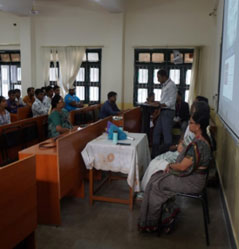
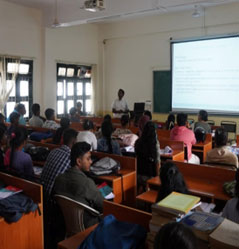
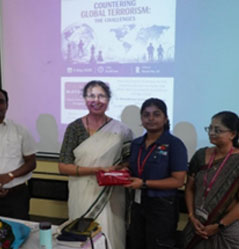
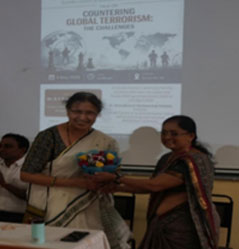
The Department of Humanities in collaboration with Gandhian Centre of Science and Human values hosted Dr. S Y Surendra Kumar for a talk on “Countering global terrorism: The challenges” on 5th May, 2026. Dr. Meenakumari Deshpandey Mahishi felicitated the winners of essay writing and poster making competitions.
The event underscored the critical need to comprehend terrorism its very meaning, underlying causes, consequences, preventive strategies and effective counter-terrorism approaches. Students were inspired to engage in critical thinking on pressing security challenges and the broader quest for global peace.
To demystify the notions on terrorism.
To understand the strategies of US, UK and India.
Enlighten students about the importance of counter- terrorism
Dr. S Y Surendra Kumar is a professor at Bangalore University bringing two decades of experience in the field of Political Science.
He holds an M.Phil. and Ph.D. in South Asian Studies from Jawaharlal Nehru University, New Delhi, and an M.A. in Political Science from Bangalore University.
He has an extensive research profile with a total of 71 publications, including 4 books, 24 book chapters, and 43 research articles in peer-reviewed journals. His recent works focus on global politics, public Policy Studies, South Asian Security, India’s Foreign Policy (reference to US & China).
He serves as Editor-in-Chief of the Journal of Contemporary Politics and the e-newsletter “Rajneeti”. He is also a member of the Editorial Board of the Journal of Polity and Society (UGC-CARE listed).
Dr. S Y Surendra Kumar enlightened students about the challenges of terrorism. Later, Dr. Meenakumari Deshpandey Mahishi, Director of Gandhi Centre of Science and Human Values, presided over the prize distribution ceremony for essay writing and poster making competitions. This encouraged students to educate themselves about Gandhian principles.
The talk provided a detailed overview of terrorism, its misconceptions, and the evolving counterterrorism strategies adopted by major countries. The speaker explained that terrorism is often misunderstood through myths, especially the claim that it is primarily driven by religion or poverty. He emphasized that terrorism is not inherently religious, and that poverty is not the direct cause of terrorism, a view supported by broader counterterrorism scholarship and policy discussions
The speaker referred to terrorist organizations such as the LTTE and Al Qaeda to illustrate how terrorism takes different forms across regions and contexts. He highlighted that terrorist movements are shaped by political, ideological, strategic, and operational factors rather than by a single root cause.
A major part of the talk focused on the counterterrorism approaches of the United States, the United Kingdom, and India. The speaker noted that these countries have adapted over time by strengthening intelligence sharing, law enforcement coordination, border security, cyber security, and legal cooperation. The talk also discussed major terrorist attacks such as 9/11 and 26/11 as turning points in global and Indian counterterrorism policy.
Another important theme was the need for secure cities alongside smart cities. The speaker argued that technological modernization must be matched with strong security infrastructure, real-time surveillance, coordination among agencies, and preparedness for emergency response.
He also noted that India and the United States have used both unilateral and multilateral arrangements to strengthen the fight against terrorism.